
Resources
Medical and dental office carpet care: a plan for the patient path
For practice and office managers: where carpet fits in a clinic, how to care for it from the entry mat to the consult room, and how to set a cleaning interval when no clinic-specific chart exists.
Carpet in a practice: where it fits
Carpet earns its place in some rooms of a medical or dental office and not in others. The waiting room, the hallway to the consult rooms and the business office are natural fits; rooms where fluids and instruments are handled are not. The Carpet and Rug Institute’s healthcare guidance backs that split: it advises against carpet in spill-prone spaces, naming emergency rooms, operating rooms and labs, while observing that public areas commonly have it.
The same guidance favors nylon for how it wears and resists abrasion, solution dyeing where spills occur, BCF yarn over staple yarn for less fuzzing, and loop pile in corridors and patient areas because it keeps its appearance. If a refresh or a new suite is on the calendar, those are the specifications to raise with the flooring company. This guide covers the carpet a practice already has.
The patient path, area by area
| Area | What crosses it | Staff habit | Cleaning interval (general CRI 204) | Sign it needs attention |
|---|---|---|---|---|
| Vestibule and entry mat | Outdoor soil, rain, every arrival | Check mats at opening and midday | Severe class: interim 12 to 52 times a year | Soil past the mat’s far edge |
| Waiting room seating | Coffee, snacks, strollers, wheelchairs | Walk the room at lunch; blot spills | Heavy class: deep clean 2 to 6 times a year | Dark halos around chair legs |
| Check-in and checkout counters | Standing queues, dropped pens and cups | Vacuum the queue line daily | Heavy class, with spot work each visit | A worn arc at the counter |
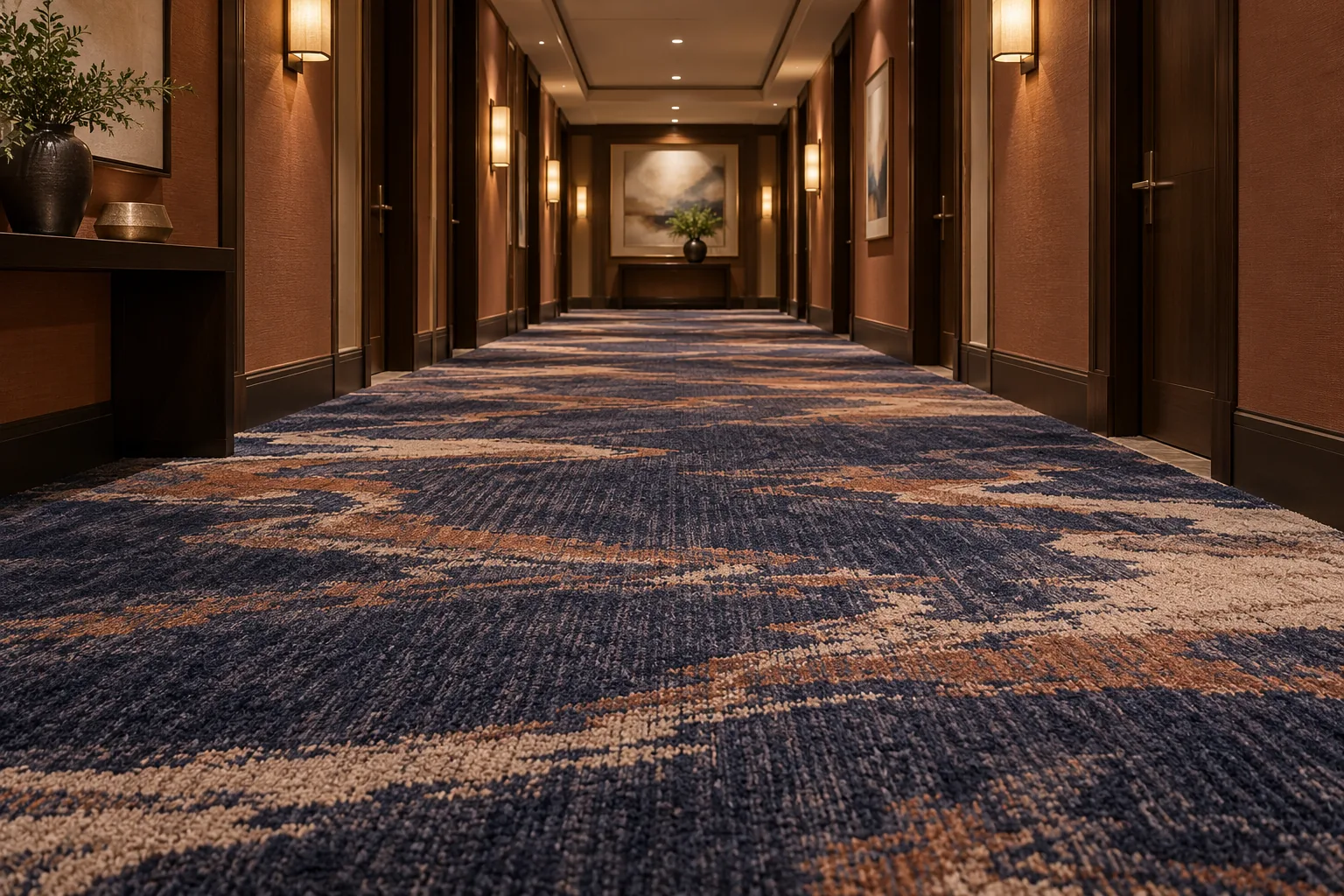
| Hallway to consult rooms | Patients, staff and rolling carts | Vacuum daily; report ripples | Heavy class: interim 6 to 12 times a year | A center lane between doorways |
| Consult and physician offices | Light traffic, desk chairs | Vacuum 2 to 3 times a week | Moderate class: deep clean once or twice a year | Chair-caster wear by the desk |
| Business office and billing | Staff only, filing traffic | Vacuum 2 to 3 times a week | Moderate class | Indentations from cabinets |
| Staff break room | Coffee, lunch, a busy microwave | Blot spills right away | Spot work on every visit | Stains that reappear after drying |
The interval column draws on CRI 204’s traffic classes for commercial carpet in general. Match each room to the class its foot traffic suggests, not to its name on the floor plan.
Setting a schedule without a clinic-specific chart
No cleaning-frequency chart is published for medical or dental offices, so this plan uses the general commercial charts and names them. CRI 204 counts deep cleans a year by traffic class: once or twice for moderate areas, 2 to 6 for heavy, and 2 to 26 for severe. Interface’s chart, built on IICRC S100, counts daily foot traffic instead, with restorative cleaning once or twice a year below 500 traffics a day and 3 to 6 times between 1,001 and 2,500.
For a single-suite practice, that puts a busy waiting room and entry on the heavy end, offices on the moderate end, and interim passes between deep cleans where patients sit. Low-moisture encapsulation suits those interim passes because the room has to be back in use for the first appointment. Our frequency guide explains both charts in full.
Spills that come back, and other clinic carpet problems
Stains that reappear. A coffee spill in a waiting room gets blotted, looks gone, and returns a day later. CRI 204 calls this wicking: as the carpet dries, liquid, soil or residue in the backing travels up into the fiber tips. Removing the liquid fully and moving air across the spot while it dries both limit it. Spills that have soaked deep belong with professional spot and stain removal.
Smells near seating. Spilled drinks, a sick child or an accident in the waiting room leave odors that sit in the backing, not just the pile. Spraying fragrance over the spot only covers it; the source has to come out of the carpet. For first steps the front desk can take, see our spill response guide.
Wheels and loose carpet. The U.S. Access Board notes that carpet raises roll resistance, and that wheelchairs are harder to maneuver on thick, cushiony or loose carpet. Ripples and lifted edges along the hallway call for an installer or flooring company, since cleaning cannot re-stretch carpet. Report them early.
Cleaning around patient hours
A practice that opens at seven and closes at six leaves the evening and the weekend for carpet work. Plan the restorative cleans for a Friday night or a long weekend, and keep the weeknight visits to interim passes and spot work in the waiting room. For how our crews behave around patient records, see our medical and dental office page.
Warranty terms and replacement timing
Warranty terms differ by manufacturer and product. Shaw’s carpet tile warranty, for example, covers fiber loss but excludes soiling and staining, and Milliken’s hospitality warranty lists shading and water marking as not defects. Interface, as one manufacturer, limits restorative cleaning to hot-water extraction in its guidelines and states that bonnet or rotary work “may void all warranties.” Read the maintenance terms in your own warranty, then share them at the walkthrough so each room’s method is chosen to fit.
No published useful-life figure exists for medical office carpet specifically. For budgeting, general commercial carpet is planned on roughly an 8- to 15-year range, drawn from a federal condition-assessment course and NIST’s life-cycle model. Inspect the waiting room and main hallway every year, since they carry the most traffic.
Questions to put to a cleaner before you book
- Which rooms get restorative cleaning, and which get interim passes?
- Will the waiting room be ready for the first patient after a weeknight visit?
- How do your crews handle charts and screens left out on desks?
- Is the quote priced by measured area?
- How will the methods fit our carpet’s warranty?
Schedule a walkthrough to have each room priced in writing.
A few useful answers
Common questions.
Should exam or procedure rooms have carpet?
Labs, operating rooms and emergency rooms are the examples CRI’s healthcare guidance gives of spill-heavy rooms where it does not recommend carpet. Waiting rooms, hallways and offices are where carpet is common.
Is there a carpet cleaning schedule written for medical offices?
No chart is published for medical offices specifically. This guide uses CRI 204’s general traffic classes and Interface’s foot-traffic chart, which apply to commercial carpet of any kind.
Why did a waiting-room stain come back after it dried?
That is wicking. Liquid or residue left in the backing climbs back to the surface while the carpet dries, so the spot reappears. Thorough extraction of the liquid and good airflow while drying limit it.
Which carpet specifications suit a waiting room?
CRI points to nylon for abrasion resistance, solution-dyed yarn where spills occur, BCF yarn for less fuzzing and loop pile in corridors and patient areas.